Contents "The internationalist proletarian" n.18
LIFE OF THE PARTY: GENERAL MEETING OF AUGUST 2026 (I)
The general meeting took place in two phases, one for study and the other for assessment and planning of activities. The sessions included both in-person and online participation by fellow members from the Party’s various regional sections.
The militant formation phase lasted one week, with the main focus on the study of various texts by Lenin.
During the study sessions, comments were made to clarify and explore the study materials in greater depth, and questions were raised that were then addressed in greater detail as part of the study, using supplementary material or more detailed explanations. The study sessions took place over 7 days in 4-hour sessions, held in the morning and afternoon, following this schedule:
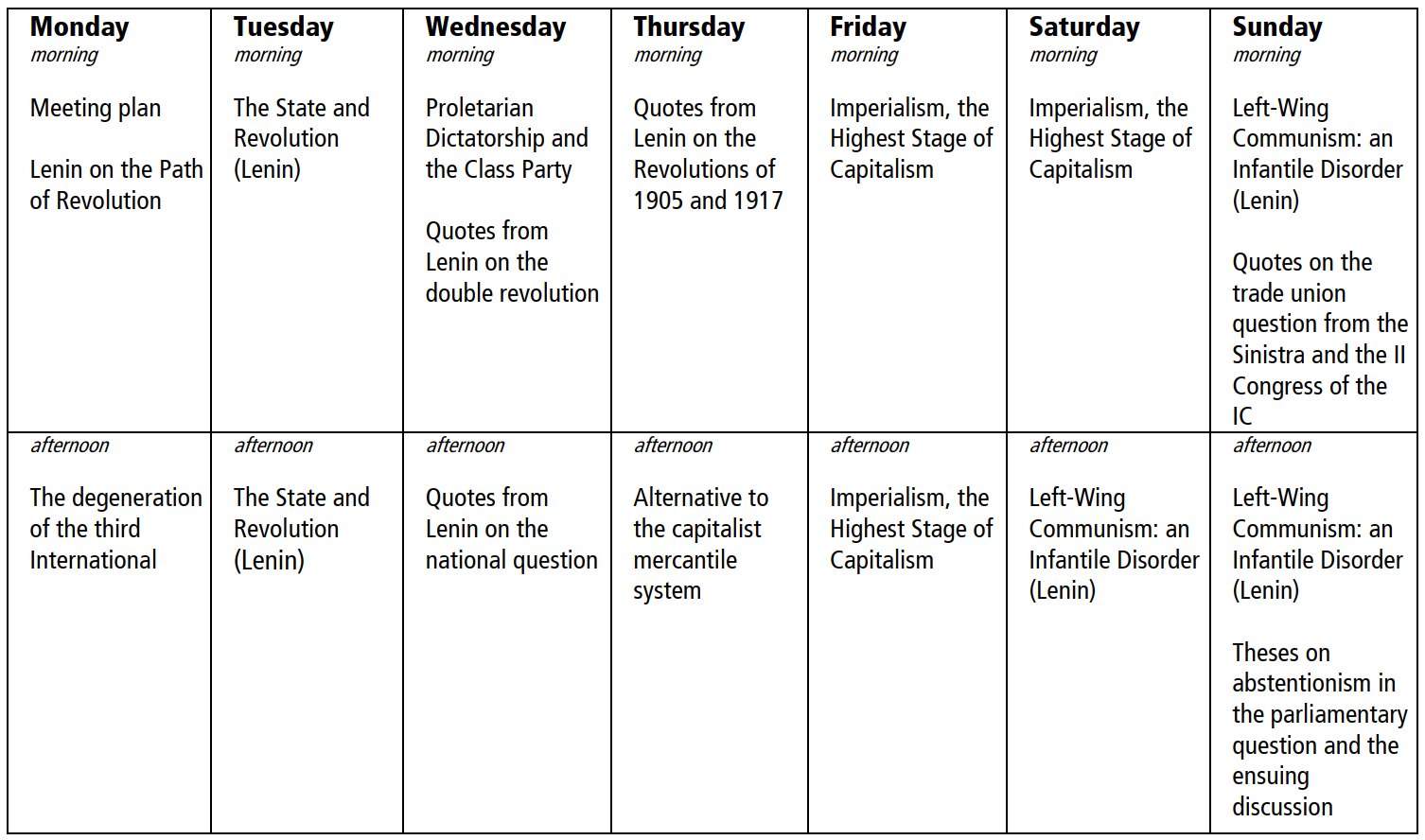
The first session focused on the general framework of the meeting and examined “Lenin on the Path of Revolution” (1924) in order to – given the number of Lenin’s texts scheduled for the study sessions – address the question of Lenin as a theorist and restorer of Marxism, as well as the Bolsheviks’ limitations on tactical issues.
As the text states: “At the beginning of The State and Revolution, Lenin himself says that it is inevitable that the great revolutionary pioneers will be falsified: as has happened with Marx and his finest followers. Will Lenin himself escape this fate? Certainly not (…) This hypocritical attitude of bourgeois thought is the almost certain prelude to other attempts at distortion – some closer to us than others – against which the militants of tomorrow have a duty to fight: a duty to absorb, if not with the same genius, then with the same determination that Lenin demonstrated in relation to the masters of Marxism.” (Lenin on the Path of Revolution, 1924).
Returning to this prediction, the Party text “‘Left-Wing Communism: An Infantile Disorder,’ A Condemnation of Future Renegades” (1964) states: “Thirty-six years have passed since this facile prediction, and its assessment, forged step by step by the left’s relentless criticism, shows that the volume of falsifying garbage that opportunism has attempted to heap upon the figure of Lenin is at least ten times more nauseating than that thrown at Marx. The vile method of the falsifiers is always the same: to construct a legend in place of the historical reality that gave rise to the formation of the method and program of those great communists; to fish within that legend for isolated, artificial quotations, severed from the actual conditions of struggle that led to the creation of these classic texts; and shamelessly distort their value by taking advantage of the difficult conditions of struggle faced by the revolutionary class, which, in most cases, due to the economic hardship in which it lives, must content itself with acquiring its arsenal of theoretical weapons from third- and fourth-hand sources.”
And this is why, in the face of so many subsequent falsifications of Lenin’s positions, it is necessary to guide our study by following the method our Party has always used: examining the collection of Lenin’s quotations in their historical order and context: “Dishonest use of Lenin. This is the true method of the dealers in doctrine: to point to a volume in the official series and a page in that volume, confident that purges and censorship have combed through the entire edition, just as a Catholic cites the canonical text of the Gospels. And deliberately omitting the date and subject of the text, that is, its historical context, the front lines on which it was written by someone who was not an archivist, but a fighter – he certainly was – of revolutionary action. (…) Lenin’s entire body of work and life speak for themselves, not just two sentences. (…) We have countered this disloyal way of quoting Lenin with a study, in its historical order, of his writings throughout the course of the revolutionary struggle in Russia” (Dialogue with the Dead, 1956).
The Party's method is not easy – it can even drive activists and revisionists to the brink of madness[1] – but it is the only one that, when applied systematically, leads to the training of militants capable of defending a coherent Marxist line:
“We recognize that reading Lenin or Marx in this way is laborious. But it is the only way to guard against widespread opportunist ruin. Anyone who wants to take the easy way out and anyone who wants to be content with platitudes and fraudulently cherry-picked phrases should find their place in the dungheap.” (’Left-Wing Communism: An Infantile Disorder,’ A Condemnation of Future Renegades, 1964).
The text under study also addresses, in general terms, the issue of Party leaders and Party organization in the key chapter “The Role of the Leader”:
“The expression and role of the individual are determined by the general conditions of the environment, society, and its history. What takes shape in a person’s mind has been shaped by their relationships with others. Certain privileged and well-trained minds, better-constructed and more refined machines, better translate, express, and rework a body of knowledge and experience that would not exist if it were not grounded in the life of the community. Rather than inventing, the leader represents the masses themselves and enables them to recognize themselves more and more clearly in their situation with respect to the social world and historical development; to express in precise external formulations their tendency to act in that direction, for which the conditions are provided by social factors, whose mechanism is ultimately interpreted on the basis of an investigation of economic elements. (…) The leader’s mind is a material instrument that functions through its ties to the entire class and the party; the formulations the leader articulates as a theorist and the norms the leader prescribes as a practical leader are not his own creations, but rather clarifications of a consciousness whose materials belong to the class-party and are the product of vast experience. (…) Leaders and the leader are those who best and most effectively organize the class’s thought and want its will, necessary and active constructions of the premises provided by historical factors. (…) The party organization, which enables the class to truly be itself and live as such, presents itself as a unified mechanism in which the various «brains» (not only brains, of course, but also other individual organs) take on diverse tasks according to their aptitudes and potential, all in the service of a goal and an interest that progressively unify more and more intimately «in time and space» (this convenient expression has an empirical, not a transcendent, meaning). Not all individuals, therefore, hold the same position or carry the same weight within the organization: to the extent that this division of labor is carried out according to a more rational plan (and what holds true today for the party–class will hold true tomorrow for society), it is absolutely impossible for those at the top to exert a privileged influence over the others. Our revolutionary evolution is not moving toward disintegration, but toward an increasingly scientific connection among individuals.
It is anti-individualist insofar as it is materialist; it does not believe in the soul or in a metaphysical and transcendent essence of the individual, but rather places the individual’s functions within a collective framework, creating a hierarchy that evolves toward the gradual elimination of coercion, replacing it with technical rationality. The party is already an example of a collective free from coercion. (…) These general aspects of the issue show that no one better than us rises above the banal meaning of egalitarianism and «numerical» democracy. If we do not believe in the individual as a sufficient basis for action, what value can the sheer number of individuals have for us? What can democracy or autocracy mean to us? (…) For us, the question does not arise in legal terms, but as a technical problem not prejudged by syllogisms of constitutional law or, worse still, natural law. There is no principled reason for our bylaws to include the terms «leader» or «committee of leaders»:
And from these premises arises a Marxist solution to the question of choice: a choice determined, above all, by the dynamic history of the movement and not by the banality of electoral contests. We prefer not to include the word «leader» in our organizational rules because we will not always have in our ranks a figure of the stature of a Marx or a Lenin. In conclusion, if such an exceptional individual, the «instrument», exists, the movement makes use of him; but the movement continues to thrive even when no such eminent figure is present.”
During the second session, we studied the material prepared as part of the series on the historical line of the degeneration of the Third International (https://siguiendo-el-hilo-del-tiempo.web.app/), which has been published in the journal. The work carried out at the general meeting in August 2023, which takes form in this web application, allows for an in-depth study of the degeneration of the International and also enables an intensive study session of approximately four hours (including comments and clarifications) on this part of the history of the communist movement, whose lessons are essential for the resumption of the class struggle. This aspect was also crucial for properly contextualizing the reading of Lenin’s texts scheduled for the study sessions – and especially “Left-Wing Communism: An Infantile Disorder” – for the reasons outlined above.
During the third and fourth sessions, we studied “The State and Revolution” by Lenin. As noted in point 11 of the Naples Theses, “The theoretical question [of the state] after Lenin requires no further clarification,” and therefore the study of this text is an important part of the formation of communist militants.
First of all, and contrary to all those who seek to portray Lenin as a vulgar revisionist who invented a theory different from Marxism, this comrade’s purpose could not be clearer: “In these circumstances, in view of the unprecedently wide-spread distortion of Marxism, our prime task is to re-establish what Marx really taught on the subject of the state”.
But the method Lenin employs for this restoration is also extremely revealing: “This will necessitate a number of long quotations from the works of Marx and Engels themselves. Of course, long quotations will render the text cumbersome and not help at all to make it popular reading, but we cannot possibly dispense with them. All, or at any rate all the most essential passages in the works of Marx and Engels on the subject of the state must by all means be quoted as fully as possible so that the reader may form an independent opinion of the totality of the views of the founders of scientific socialism, and of the evolution of those views, and so that their distortion by the “Kautskyism” now prevailing may be documentarily proved and clearly demonstrated”.
In other words, Lenin applies the same method to the study of Marx and Engels’ texts that we must apply to the study of Marxism in general, including Lenin and the Party’s texts. This method, which discourages the creativity of innovators but lays the groundwork for a militant commitment grounded in understanding and in the prevention of surprise or sudden shifts in direction at critical moments, consists of reproducing quotations from fundamental texts to guide any position and as a basis for the struggle against any attempt to revise the theses of Marxism, a method consistently advocated by the Party: “The main objective of our discussions – in which it is essential to continually repeat certain assertions of the fundamental «theorems», preferably using the same words and phrases – is to critique the delusion regarding «unforeseen» forms and deformities of modern capitalism that would force us to revise the foundations of «prospectivism» and, consequently, of the Marxist method.
Such a false position can easily be attributed to ignorance, or rather to never having known, the essential lines of our doctrine, its cardinal principles.” (The Soul of the Steam Horse, Il Programma Comunista No. 5, 1953)
“It is useless and harmful to specify or personalize, and to search far and wide or nearby for the source of the bacteriological bombs; the point is to identify the virus and apply the antibiotic, which we stubbornly distinguish through continuity of line, through fidelity to principles, through preferring nine hundred ninety-nine times out of a thousand the catechist remastication over the adventure of new scientific discovery that requires eagle’s wings, and to which every mosquito feels called by destiny. (…) Therefore, while far too many are caught up in the hysteria of sublime calculation, we classify them as being at the level of the abacus, and we check to see if they know how to count on their fingertips.” (The Marxism of the Stammerers, Battaglia Comunista, No. 8, 1952).
Drawing on Marx’s quotations, Lenin unravels the mechanisms by which parliamentarism and the democratic republic serve as instruments for the domination of the bourgeoisie:
“At present, imperialism and the domination of the banks have “developed” into an exceptional art both these methods of upholding and giving effect to the omnipotence of wealth in democratic republics of all descriptions. Since, for instance, in the very first months of the Russian democratic republic, one might say during the honeymoon of the “socialist” S.R.s and Mensheviks joined in wedlock to the bourgeoisie, in the coalition government. Mr. Palchinsky obstructed every measure intended for curbing the capitalists and their marauding practices, their plundering of the state by means of war contracts; and since later on Mr. Palchinsky, upon resigning from the Cabinet (and being, of course, replaced by another quite similar Palchinsky), was “rewarded” by the capitalists with a lucrative job with a salary of 120,000 rubles per annum — what would you call that? Direct or indirect bribery? An alliance of the government and the syndicates, or “merely” friendly relations? What role do the Chernovs, Tseretelis, Avksentyevs and Skobelevs play? Are they the “direct” or only the indirect allies of the millionaire treasury-looters?”
“Another reason why the omnipotence of “wealth” is more certain in a democratic republic is that it does not depend on defects in the political machinery or on the faulty political shell of capitalism. A democratic republic is the best possible political shell for capitalism, and, therefore, once capital has gained possession of this very best shell (through the Palchinskys, Chernovs, Tseretelis and Co.), it establishes its power so securely, so firmly, that no change of persons, institutions or parties in the bourgeois-democratic republic can shake it.”
To reiterate later: “We must also note that Engels is most explicit in calling universal suffrage as well an instrument of bourgeois rule.”
Lenin recovers Marx and Engels’ critique of the misleading slogan of the “free people’s State” and the need to address the question of the State in propaganda and agitation: “Every state is a “special force” for the suppression of the oppressed class. Consequently, every state is not “free” and not a “people’s state”. Marx and Engels explained this repeatedly to their party comrades in the seventies. (...) This, “no one remembers”. It is not done in modern socialist parties to talk or even think about the significance of this idea, and it plays no part whatever in their daily propaganda and agitation among the people”.
Here is a review of the moments of the state’s “defeat” and “extinction,” which have been misrepresented for decades by German social democracy: “According to Engels, the bourgeois state does not “wither away” but is “abolished” by the proletariat in the course of the revolution. What withers away after this revolution is the proletarian state or semi-state”.
This clarification is essential because the bourgeois state must be destroyed through a violent revolution, but this is not enough, and the proletariat still needs an instrument of repression with the dual purpose of crushing the resistance of the bourgeoisie and implementing measures for socialist transformation: “The theory of class struggle, applied by Marx to the question of the state and the socialist revolution, leads as a matter of course to the recognition of the political rule of the proletariat, of its dictatorship, i.e., of undivided power directly backed by the armed force of the people. The overthrow of the bourgeoisie can be achieved only by the proletariat becoming the ruling class, capable of crushing the inevitable and desperate resistance of the bourgeoisie, and of organizing all the working and exploited people for the new economic system”.
From this and based on Marx’s famous letter to Weydemeyer dated March 5, 1852, we arrive at the unequivocal conclusion: “To confine Marxism to the doctrine of class struggle is to limit Marxism, to distort it, to reduce it to something the bourgeoisie can accept. Only those who extend the recognition of the class struggle to the recognition of the dictatorship of the proletariat are Marxists.”
Lenin returns to the fundamental issue of the Marxist critique of parliamentarism: “To decide once every few years which members of the ruling class is to repress and crush the people [2] through parliament – this is the real essence of bourgeois parliamentarism, not only in parliamentary-constitutional monarchies, but also in the most democratic republics”.
This criticism is deliberately forgotten by opportunists: “This remarkable criticism of parliamentarism, made in 1871, also belongs now to the “forgotten words” of Marxism. The professional Cabinet Ministers and parliamentarians, the traitors to the proletariat and the “practical” socialists of our day, have left all criticism of parliamentarism to the anarchists, and, on this wonderfully reasonable ground, they denounce all criticism of parliamentarism as “anarchism”!!”
Under capitalism, democracy and parliamentarism are a farce that excludes the working class from any effective participation in power.
“Democracy for an insignificant minority, democracy for the rich – that is the democracy of capitalist society. If we look more closely into the machinery of capitalist democracy, we see everywhere, in the “petty” – supposedly petty – details of the suffrage (residential qualifications, exclusion of women, etc.), in the technique of the representative institutions, in the actual obstacles to the right of assembly (public buildings are not for “paupers”!), in the purely capitalist organisation of the daily press, etc., etc., - we see restriction after restriction upon democracy. These restrictions, exceptions, exclusions, obstacles for the poor seem slight, especially in the eyes of one who has never known want himself and has never been in close contact with the oppressed classes in their mass life (and nine out of ten, if not ninety-nine out of a hundred, bourgeois publicists and politicians come under this category); but in their sum total these restrictions exclude and squeeze out the poor from politics, from active participation in democracy”.
Lenin then goes on to outline the specific measures to be implemented for the abolition of parliamentarism in the socialist transformation:
- Equalization of compensation to the level of a worker
- Immediate revocability
- Participation of the entire working class in the exercise of power
- General reduction of the working day
“The workers, after winning political power, will smash the old bureaucratic apparatus, shatter it to its very foundations, and raze it to the ground; they will replace it by a new one, consisting of the very same workers and other employees, against whose transformation into bureaucrats the measures will at once be taken which were specified in detail by Marx and Engels: (1) not only election, but also recall at any time; (2) pay not to exceed that of a workman; (3) immediate introduction of control and supervision by all, so that all may become “bureaucrats” for a time and that, therefore, nobody may be able to become a “bureaucrat”.“
“Under socialism much of “primitive” democracy will inevitably be revived, since, for the first time in the history of civilized society the mass of population will rise to taking an independent part, not only in voting and elections, but also in the everyday administration of the state. Under socialism all will govern in turn and will soon become accustomed to no one governing”.
“The possibility of this destruction is guaranteed by the fact that socialism will shorten the working day, will raise the people to a new life, will create such conditions for the majority of the population as will enable everybody, without exception, to perform “state functions”, and this will lead to the complete withering away of every form of state in general”.
As can be seen, the goal is to maximize the direct and active participation of the entire working class, led by the Party, in the revolutionary transformation and in the exercise of power.
Lenin’s use of the word “democracy” in the text provides a potential support for those who want to bring parliamentarism back in through the window after Lenin had thrown it out the door. As we know, “Formulas and terms may be distorted by traitors and fools, but their use is always a guide when it is consistent and coherent.” (The Revolutionary Program of Communist Society Abolishes All Forms of Ownership of Land, Installations of Production, and the Products of Labor, 1958).
For Lenin, workers’ democracy is directly synonymous with the dictatorship of the proletariat, not a way to undermine the latter. In these quotes, democracy means the broadest possible participation, through the measures listed, of the working class in the exercise of the dictatorship against the bourgeoisie. But all those who, after him, prefer the term “workers’ democracy” do so because they want to avoid class dictatorship and maintain parliamentarism; therefore, we will steer clear of this term, following the Manifesto’s slogan that “The Communists disdain to conceal their views and aims” and Lenin’s own explanation “The whole point is that a bourgeois state which is exercising the dictatorship of the bourgeoisie through a democratic republic cannot confess to the people that it is serving the bourgeoisie; it cannot tell the truth, and has to play the hypocrite. But the state of the Paris Commune type, the Soviet state, openly and frankly tells the people the truth and declares that it is the dictatorship of the proletariat and the poor peasants; and by this truth it wins over scores and scores of millions of new citizens who are kept down in any democratic republic, but who are drawn by the Soviets into political life, into democracy, into the administration of the state.” (The Proletarian Revolution and the Renegade Kautsky, Lenin, 1918).
If we have seen above the mechanism by which the bourgeoisie exercises its dominance through immediate and deferred bribery, it becomes clear that the aforementioned measures would be ineffective if companies and the market-based system were allowed to survive. Even if officials’ compensation were reduced, it would still be a very good investment to spend some time doing favors for capitalists while receiving a low official salary, in order to later secure a well-paid position. This aspect is the one we will now explore in greater depth:
“Engels here approached the interesting boundary line at which consistent democracy, on the one hand, is transformed into socialism and, on the other, demands socialism. For, in order to abolish the state, it is necessary to convert the functions of the civil service into the simple operations of control and accounting that are within the scope and ability of the vast majority of the population, and, subsequently, of every single individual. And if careerism is to be abolished completely, it must be made impossible for “honourable” though profitless posts in the Civil Service to be used as a springboard to highly lucrative posts in banks or joint-stock companies, as constantly happens in all the freest capitalist countries.”
This requires the expropriation of the means of production and the outlawing of the bourgeoisie: the only freedom for the working class lies in the deprivation of the bourgeoisie’s freedom. Recalling that “Taken separately, no kind of democracy will bring socialism” (...) And the dictatorship of the proletariat, i.e., the organization of the vanguard of the oppressed as the ruling class for the purpose of suppressing the oppressors, cannot result merely in an expansion of democracy. Simultaneously with an immense expansion of democracy, which for the first time becomes democracy for the poor, democracy for the people, and not democracy for the money-bags, the dictatorship of the proletariat imposes a series of restrictions on the freedom of the oppressors, the exploiters, the capitalists. We must suppress them in order to free humanity from wage slavery, their resistance must be crushed by force; it is clear that there is no freedom and no democracy where there is suppression and where there is violence.”
Lenin continues: “Engels expressed this splendidly in his letter to Bebel when he said, as the reader will remember, that “the proletariat needs the state, not in the interests of freedom but in order to hold down its adversaries, and as soon as it becomes possible to speak of freedom the state as such ceases to exist”.
Democracy for the vast majority of the people, and suppression by force, i.e., exclusion from democracy, of the exploiters and oppressors of the people—this is the change democracy undergoes during the transition from capitalism to communism.”
However, this is not the end goal; it is merely a necessary step: “When the majority of the people begin independently and everywhere to keep such accounts and exercise such control over the capitalists (now converted into employees) and over the intellectual gentry who preserve their capitalist habits, this control will really become universal, general, and popular; and there will be no getting away from it, there will be “nowhere to go”.
The whole of society will have become a single office and a single factory, with equality of labour and pay. But this “factory” discipline, which the proletariat, after defeating the capitalists, after overthrowing the exploiters, will extend to the whole of society, is by no means our ideal, or our ultimate goal. It is only a necessary step for thoroughly cleansing society of all the infamies and abominations of capitalist exploitation, and for further progress.”
The following quotes speak for themselves:
“For when all have learned to administer and actually do independently administer social production, independently keep accounts and exercise control over the parasites, the sons of the wealthy, the swindlers and other “guardians of capitalist traditions”, the escape from this popular accounting and control will inevitably become so incredibly difficult, such a rare exception, and will probably be accompanied by such swift and severe punishment (for the armed workers are practical men and not sentimental intellectuals, and they scarcely allow anyone to trifle with them), that the necessity of observing the simple, fundamental rules of the community will very soon become a habit.
Then the door will be thrown wide open for the transition from the first phase of communist society to its higher phase, and with it to the complete withering away of the state.”
“(…) In striving for socialism, however, we are convinced that it will develop into communism and, therefore, that the need for violence against people in general, for the subordination of one man to another, and of one section of the population to another, will vanish altogether since people will become accustomed to observing the elementary conditions of social life without violence and without subordination. In order to emphasize this element of habit, Engels speaks of a new generation, “reared in new, free social conditions”, which will “be able to discard the entire lumber of the state” – of any state, including the democratic-republican state”.
“Only in communist society, when the resistance of the capitalists has been completely crushed, when the capitalists have disappeared, when there are no classes (i.e., when there is no distinction between the members of society as regards their relation to the social means of production), only then “the state ... ceases to exist”, and “it becomes possible to speak of freedom”. Only then will a truly complete democracy become possible and be realised, a democracy without any exceptions whatever. And only then will democracy begin to wither away, owing to the simple fact that, freed from capitalist slavery, from the untold horrors, savagery, absurdities, and infamies of capitalist exploitation, people will gradually become accustomed to observing the elementary rules of social intercourse that have been known for centuries and repeated for thousands of years in all copybook maxims. They will become accustomed to observing them without force, without coercion, without subordination, without the special apparatus for coercion called the state.”
(continued in the next issue)
[1] One of the manifestations of the degeneration of the Party’s French and Italian leaderships, which had been accumulating since 1972 and accelerated at full speed in 1980–1982, was the elimination of the study of fundamental texts for sympathizers and even for Party members. The circular from the BCI (Bureau Centrale Internazionale) addressed to the entire Party regarding “Work with Sympathizers and the Integration of New Members” (dated June 1981, which reached us in late November) marked a point of no return for the Spanish section. This circular outlined the process for training the “new” type of member for the new phase, breaking with the method of training sympathizers and members that had been followed until then within the Party, imposing a faster pace, and establishing, as a substitute for Marxist texts, “biographies of members such as the stories of Big Bill or Mama Jones, accounts of struggles such as Domitilia’s, or even simply news stories or novels that inspire the struggle.” In the staging of the expulsion of the Spanish section by the French Party leadership itself (the same leadership that, a few months later, would attempt to dissolve and liquidate the entire Party, which proves that our expulsion was part of this campaign to destroy the entire Party), the degenerate leadership accused us of the following: “the false assertion was made that a militant’s theoretical training must take place before joining the Party through an immersion in the general texts of Marxism (ranging from the “Critique of the Gotha Program” to “What Is to Be Done?”, from “The Origin of the Family… to “Speech on the Tax in Kind”, from ”History of the Working Class Movement“ to ”The State and Revolution")” (BCI circular dated 12/2/82). These were the texts that the degenerate leadership of the new course wanted to ban as study material. The new course wanted unprepared militants whom they could manipulate and immerse in interclassist movement-based activism, but they were unable to subdue the Spanish section. Well, 40 years later, we maintain the Party’s method and train our current and future members in the fundamental texts of Marxism, including, of course, “The State and Revolution” as well as the rest of the texts that the opportunists of the new course wanted to censor.
Communist militant formation does not have an end point, a moment when it is “complete”; rather, it is a continuous and ongoing process, though it must undoubtedly begin and reach a sufficient level of development before supporters can be admitted as members of the organization. We will return to this question in greater depth and detail in the next issue. It should be noted, by the way, that this BCI circular dated 2/12/82 was still being defended in 2021 by “El Proletario,” an offshoot of “le Proletáire/il Comunista” (exCombat) in Spanish in its July 2021 issue No. 23, in an article in which they crudely omit the list of texts mentioned above, which the degenerate leadership wanted to prevent from serving as a basis for the training of militants. Incidentally, the article in “El Proletario,” in addition to hailing the founding of the Communist Party of Spain as a milestone of the communist movement (a party that was stillborn and is the antithesis of the Communist Party of Italy founded in Livorno), is otherwise riddled with crude falsehoods, such as the claim that in issue No. 2 of “El Comunista” we had claimed that it was not a Party organ (when that issue, like all the others, clearly states “International Communist Party” as the first subtitle on the cover). This is the deceptive style that has characterized “il Comunista” (exCombat) ever since it joined the leadership of “il programma comunista” after forcing the expulsion of the Ivrea and Turin sections in 1981, when it took complete control of “il programma comunista” and published the three most repugnant issues ever published in that journal (issues 8, 9, and 10 of 1983) while simultaneously reinstating democratic centralism; when they began publishing “Combat” (whose launch was announced in issue 10 of “il programma comunista”), which was no longer considered an organ of the Party, thereby aligning themselves with the formal liquidators; and when they latched onto the French “le Prolétaire” – which, like them, was in the midst of a movementist drift – to re-present themselves as the Party’s organ (in the Italian “il Comunista” from then on) and begin to lie and distort the history of the Party’s degeneration that they themselves had spearheaded, with the aim of covering up their active and nefarious role in it.
[2] Regarding the use of the word “people” in this quote and in others that follow, Lenin makes the following observation: “In Europe in 1871, the proletariat did not constitute the majority in a single country on the continent. A ‘popular’ revolution—one that would truly draw the majority into the movement — could only be one that encompassed both the proletariat and the peasantry. (…) Consequently, when speaking of a ‘truly popular revolution,’ Marx — without in any way overlooking the characteristics of the petty bourgeoisie (about which he spoke at length and frequently) — took into account with the utmost precision the actual class relations in most of the continental European states in 1871.“ In a subsequent issue of the journal, we will publish a study on the quantitative and qualitative leap that has occurred worldwide in this regard.
<<The historical cycle of the degeneration of the 3rd International (VI)
>>Energy supply spasms, trade war, debt, and overproduction